The Compute Bill Nobody Budgeted For
Why AI Transfer Learning is Breaking the Bank
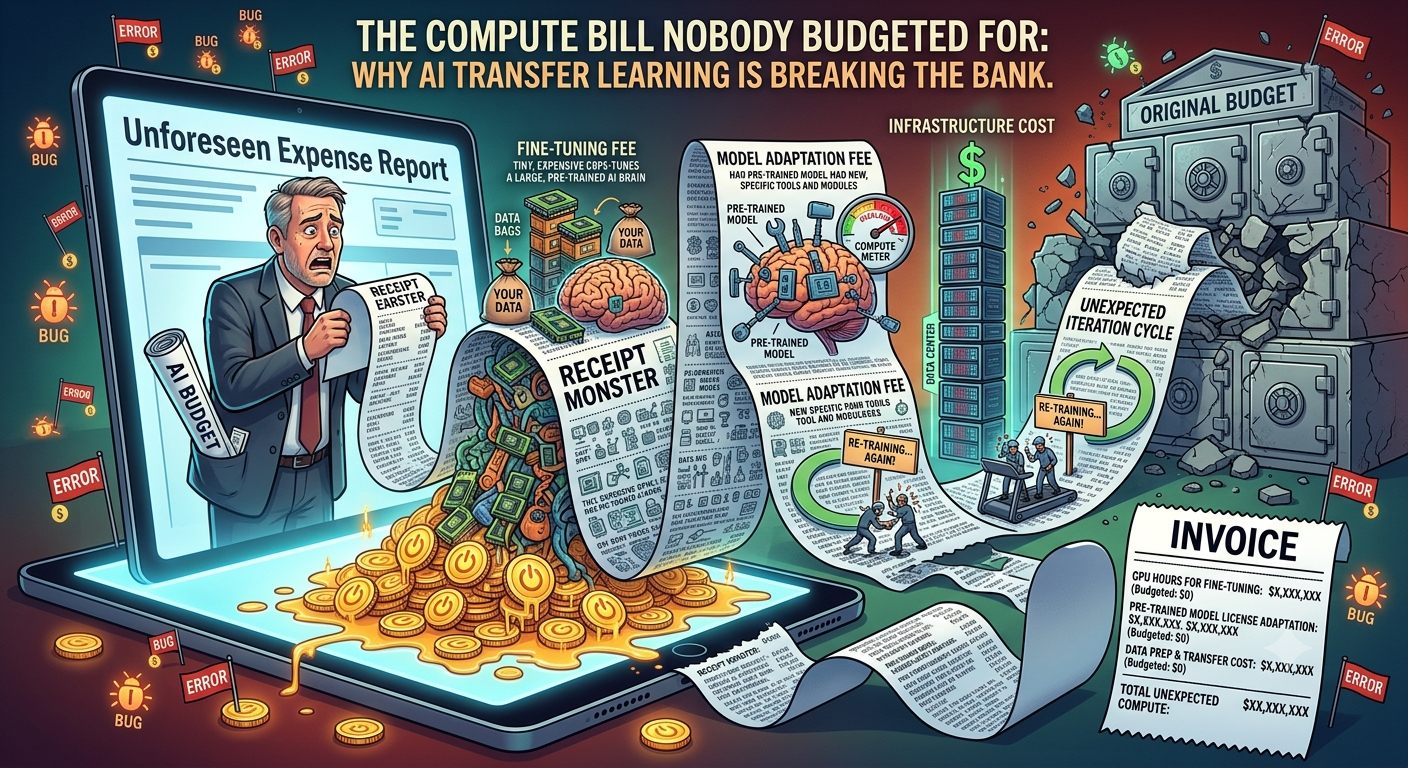
You’ve seen the pattern. The initial AI prototype is built in record time. It works beautifully in the sandbox, the board is thrilled, and the investor team calculates a seemingly reasonable budget to take the application to market.
Then, reality hits.
Getting that promising AI to work seamlessly for your end users in the real world suddenly becomes a financial sinkhole. The final stages of application development are dominated by the unexpected, astronomical costs of obtaining edge-case data and endless retraining cycles.
If you are a CEO or a technical decision-maker wondering why your AI budget is hemorrhaging compute costs just to fix minor bugs, you aren’t alone. The news cycle is flooded with companies realizing that AI is far more expensive than original planners realized. The root cause isn’t your team; it’s the fundamental way we currently train AI.
The Deceptive Cost of Transfer Learning
AI development today rarely starts from scratch. It begins with a foundational model, a massive, open-source AI trained on billions of parameters of images, text, or sound. To make it work for your specific business, your engineers train what is known as the top layer using your company’s proprietary data.
This top layer might also be referred the “classification head,” or the “output layer.” You can think of it as the ultimate decision-maker of the application. It is the part of the AI that maps the general knowledge of the foundational model to your specific task’s output. It dictates exactly how the AI should recognize your proprietary data and what it should do with it.
Transfer learning, the process of training this top layer, was designed to reduce the impossibly high costs of training foundational models from scratch. But even training this top layer is deceptively costly. Small and medium companies are experiencing massive budget overruns just trying to get this single, highly specialized layer to work perfectly.
Here is why the costs spiral out of control:
1. The Edge-Case Data Dilemma
Everyday use cases are easy to capture. But real-world applications are full of “corner cases”—rare, unique situations the AI handles poorly unless explicitly trained.
Unlike a human brain, which can learn from a single novel experience, traditional AI requires balanced data. To teach the AI a rare edge case, engineers need as many examples of that rare event as they have of everyday events. Because this data is scarce, AI engineers are forced to extrapolate and generate synthetic data using complex, highly error-prone statistical methods. You often don’t discover the errors until the model fails in production.
2. The Vicious Cycle of Retraining
As your product goes live and real customers aggregate novel problems, your team has to fix them. You might be at 70% accuracy, but getting to that enterprise-grade 99.9% requires constant iteration.
Mathematically, traditional neural networks suffer from an exponential scaling problem. Every time you perfect the model and add new edge-case data, the total dataset grows. Because current algorithms suffer from “catastrophic forgetting”, where learning something new overwrites what was previously learned, engineers must retrain the model on the entire ever-growing dataset just to make a small adjustment.
As the dataset size increases, the compute cost increases. You get bigger budgets, higher cloud bills, and slower release cycles.
Throwing GPUs at an Algorithm Problem
When faced with these bottlenecks, the standard industry advice is to add more GPUs and gather more data. But exponentially increasing costs and big data are just symptoms of a deeper disease: the underlying algorithms.
If the use cases are complex, simply adding more hardware eventually hits a ceiling. What needs to occur for AI to continue scaling viably is a fundamental switch in the training algorithm itself. We don’t necessarily need to abandon our current hardware; we need algorithms that use those GPUs to do more, process complex data flexibly, and step off the exponential treadmill of traditional training.
The Solution: Flash Transfer Learning
The budget overruns you see today are scalability problems. The solution is to do more with the hardware you already have, in a way that doesn’t rely on massive datasets.
This is where Optimizing Mind changes the paradigm.
Optimizing Mind accelerates the current training process on top of foundational models. The base model remains the same, but the top transfer-learning layer is replaced with a brain-inspired algorithm that scales efficiently and bypasses the limitations of current transfer learning methods.
Here is how Optimizing Mind’s Flash Transfer Learning API solves the compute crisis:
- Drastically Reduced Data Needs: It achieves high accuracy using just 1% of the training data required by conventional methods. You no longer need to synthetically balance massive datasets for rare edge cases.
- Zero Catastrophic Forgetting: This is the game-changer. Flash Transfer Learning allows you to add new classes and data incrementally. You can adjust the algorithm for a new edge case without disturbing or retraining the old data.
- Multiplicative Cost Savings: By eliminating the need to retrain from scratch for every minor adjustment, you require 100x less compute and rehearsal time.
An adjustment becomes exactly that—a quick, flexible adjustment—rather than a multi-day, computationally exhausting overhaul.
Stop Budgeting for Inefficiency
Every small increment in data will add up exponentially as your use case grows toward the final product. Prepare now, and avoid the compute bill no one budgeted for.
Optimizing Mind offers a white-label, drop-in API that integrates seamlessly with your existing ML pipelines, including TensorFlow and PyTorch.
Your next step: verify the Performance Shift
Have your CTO and lead machine learning engineers evaluate the speed, data requirements, and pipeline simplicity directly:
- Watch the Live Demo: Review performance metrics and side-by-side training comparisons at optimizingmind.com/flash-transfer-learning-demo.
- Test the API: Request access to the Flash Transfer Learning API at optimizingmind.com to benchmark your existing top-layer transfer pipelines.
Addressing training scalability at the algorithmic level lets your team move from prototype to production deployment without facing the compute bill nobody budgeted for. Train less, learn more, and ship your AI application on budget.